
"Treasury yields will remain at high levels"... Warning of 'handover' due to Fed's shrinking holdings
An analysis suggests that U.S. Treasury yields are unlikely to return to past low levels and will instead remain high due to a structural "handover" where Treasury holdings shift from the Fed to the private sector.
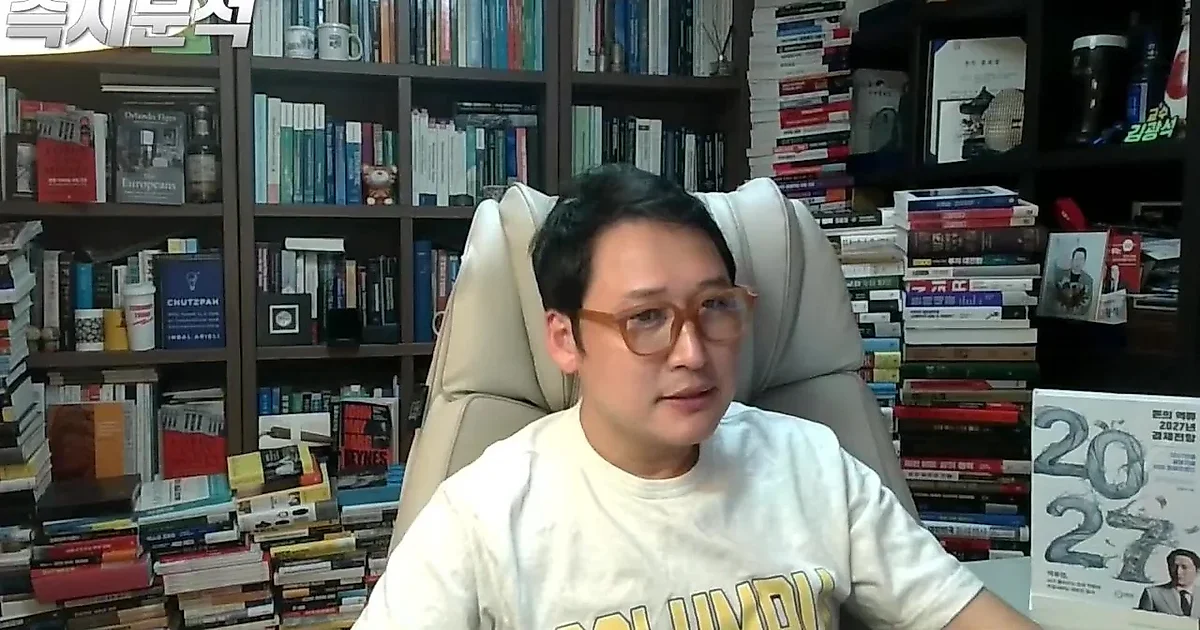
An analysis has emerged suggesting that U.S. Treasury yields are likely to remain at high levels rather than returning to the low levels seen in the past. This is due to structural factors stemming from a 'handover' phenomenon, where the volume of Treasury bonds held by the Fed is being transferred to the private sector.
"Like exchange rates, Treasury yields may form a structural peak"
Economic YouTuber Kim Kwang-seok (The Man Who Explains the Economy) diagnosed the future trend of Treasury yields through a recent live broadcast. In the video, Professor Kim predicted that even if Treasury yields fall, they will maintain high interest rate levels rather than returning to the low-interest-rate era of the past.
Professor Kim compared this to the phenomenon of exchange rates. He explained that it is similar to the principle where, even if the exchange rate falls, it does not return to the previous 1,100 won level but remains at a high level in the 1,300 won range. He pointed out that structural factors exist that cause Treasury yields to hover at high levels for a long time, and identified the 'Treasury handover' as the fundamental cause that keeps interest rates high, in addition to short-term factors that cause interest rate fluctuations.
In the video, this was explained using the expression 'backflow.' It refers to a phenomenon where the flow changes and does not accumulate in the places where sediment (sand) usually accumulates. In the video, he emphasized the impact of such structural changes on interest rates, stating, "Due to the backflow, the places where sediment accumulates have changed somewhat."
Reduction in Fed's holdings and high interest rate demands from the private sector
The core of the handover lies in who holds the U.S. Treasuries. Professor Kim analyzed the U.S. Treasury holding ratio by dividing it into 'Fed' and 'non-Fed (private).' While the Fed has traditionally held a share of approximately 35–40% of U.S. Treasuries, it has been reducing the massive holdings it acquired through 2020–2021 since 2022 alongside quantitative tightening (QT).
The problem is the interest rate pressure that arises as the entity purchasing the Treasuries changes. The video pointed out that while the Fed does not demand relatively high interest rates, the non-Fed (private sector) does. In other words, the analysis suggests that if the central bank sells Treasuries and the private sector takes on that volume, the market will demand higher yields (interest rates), resulting in an increase in Treasury yields.
Forecast of a 0.1%p rise in interest rates if the Fed sells $200 billion
Specific numerical forecasts were also presented. Professor Kim emphasized that it is important to view the market based on the change in the total U.S. Treasury holding ratio rather than based on net purchase amounts.
If the Fed reduces its holding ratio by selling approximately $200 billion worth of Treasuries, the private sector must absorb this. In this process, it is forecasted that long-term interest rates could rise by about 0.1 percentage point (p). The core of the analysis is that this is a structural change occurring during the process of leadership in the Treasury market shifting from the central bank to the private sector.
Meanwhile, Professor Kim mentioned the launch plan for the economic AI platform 'Ncer' during the broadcast. He pointed out that many existing AIs often provide incorrect facts, such as still perceiving the Fed Chair as Powell, and stated that the service will provide answers and content recommendations based on accurate facts by learning from expert content. The platform aims to become a channel where users can find economic information instead of searching on YouTube.


0Comments
Comments are currently disabled.