
High Interest Rates Driven by AI Investment Competition... US Treasury Yields Surpass 5.2%, Raising 'New Normal' Concerns
Aggressive investment in the artificial intelligence (AI) industry is driving up US Treasury yields, with the 10-year yield exceeding 5.2%. This surge in capital demand for AI infrastructure is creating inflationary pressure and shifting the neutral interest rate, leading to concerns about a high-interest-rate "new normal."
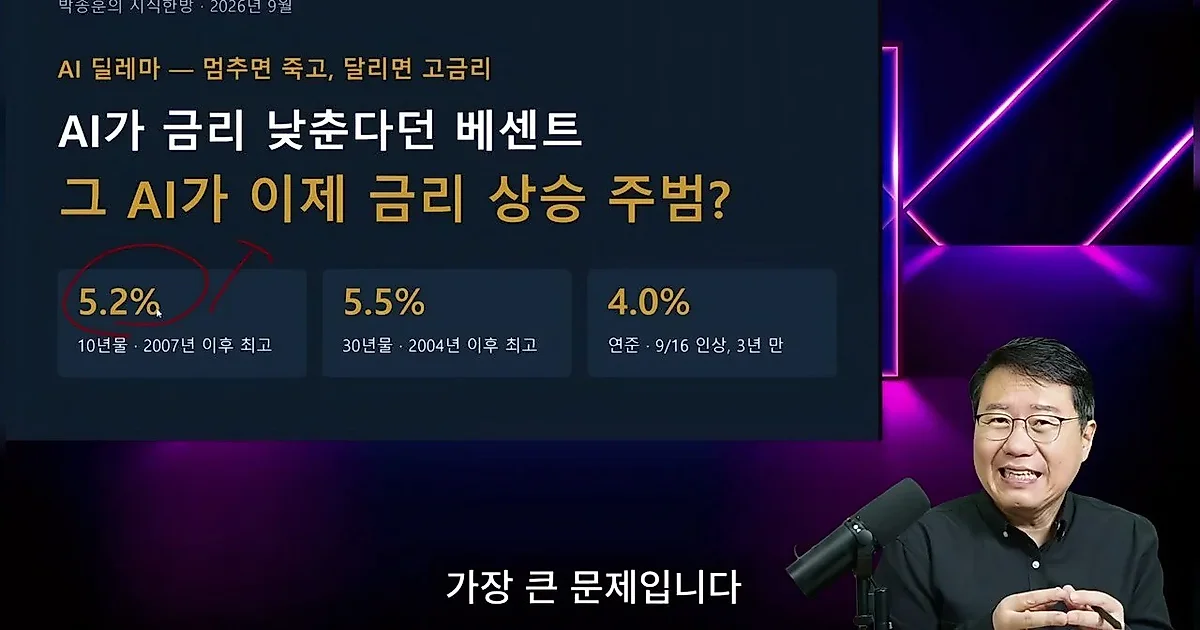
As US Treasury yields surge, increasing instability in the stock market, aggressive investment in the artificial intelligence (AI) industry is being identified as one of the major causes driving the rise in interest rates. Recently, the US 10-year Treasury yield exceeded 5.2%, reaching its highest level since 2007. The 30-year Treasury yield also recorded 5.5%, marking its highest figure since 2004.
Capital Scramble Among AI Companies and Surging Corporate Bond Issuance Outlook
As companies competitively raise funds for the development of the AI industry, upward pressure on interest rates is intensifying. According to the video, Bessent, the US Treasury Secretary, recently mentioned that AI investment is causing a short-term scramble for capital, expressing a view different from existing arguments by stating that productivity improvements will come eventually. This suggests that interest rates, the price of money, are rising as demand from AI companies to borrow funds concentrates.
The scale of specific fund demand is also substantial. According to projections from JPMorgan, the projected corporate bond issuance for big tech companies in 2027 is expected to reach $420 billion, a 60% increase from this year. Furthermore, the projected AI-related debt issuance through 2030 is estimated at $4.1 trillion. This massive demand for funds is due to AI companies investing astronomical costs to build data centers. Goldman Sachs projected that data center investment would reach $800 billion in 2026 and $1.4 trillion in 2028, which significantly exceeds the 1% investment-to-GDP ratio seen during the past IT bubble.
Rising Input Costs and Inflationary Pressure Before the Productivity Revolution
Contrary to existing expectations that AI would lower interest rates, current AI investment remains in a stage of driving up prices. This is because, before a productivity revolution occurs and lowers prices, the prices of AI-related intermediate goods and infrastructure costs rise first. As confirmed by the case of Microsoft, out of the $72 billion in increased production facility investment this year, $25 billion was caused purely by the rise in component prices.
In particular, the cost of expanding the power grid is emerging as a major variable in rising inflation. As power demand for operating AI data centers surges, pressure to increase electricity rates is growing, which served as the background for a bill passing in the United States House of Representatives to make data center operators bear the cost of the power grid. The rise in electricity rates is structured in a way that can affect overall real-life prices, such as operating ovens in bakeries or running subways. As AI input costs rise and prices increase in this manner, the Federal Reserve faces a dilemma of having to maintain high benchmark interest rates or implement additional hikes to ensure price stability.
High-Interest-Rate New Normal and Rising Risk Premiums for AI Companies
Due to structural changes in fund demand, the neutral interest rate determined by the Federal Reserve has also risen. The neutral interest rate, which was considered to be 2.5% through 2024, was recently adjusted upward to 3.2%, meaning that high interest rates have become the new standard (new normal). As the situation continues where demand to borrow money is high but supply is insufficient, an environment is being created where it is difficult to expect a decline in interest rates.
In the market, the risk premium for AI companies is also on an upward trend. Unlike general investment-grade corporate bonds, which have a spread over Treasury yields of around 0.78%, AI-related corporate bonds are carrying a high spread of 1.15 percentage points. Additionally, as the current US 10-year Treasury yield reaches 5.2%, a peculiar phenomenon is appearing where the profit margins of S&P 500 companies and Treasury yields show similar levels. This demonstrates that the upward pressure on interest rates is strong enough that the yield on stocks, which are risky assets, becomes similar to the yield on Treasuries, which are safe assets.



0Comments
Comments are currently disabled.