
US Treasury Yields Surpass 5%... Warnings of AI Bubble Burst and Stock Price Correction
Professor Kim Young-ik warns that rising US Treasury yields, which have reached their highest levels since 2002, could trigger a decline in stock prices and a contraction in AI-related investments. He highlights structural imbalances caused by fiscal deficits and a lack of demand for US debt as primary drivers of high interest rates.
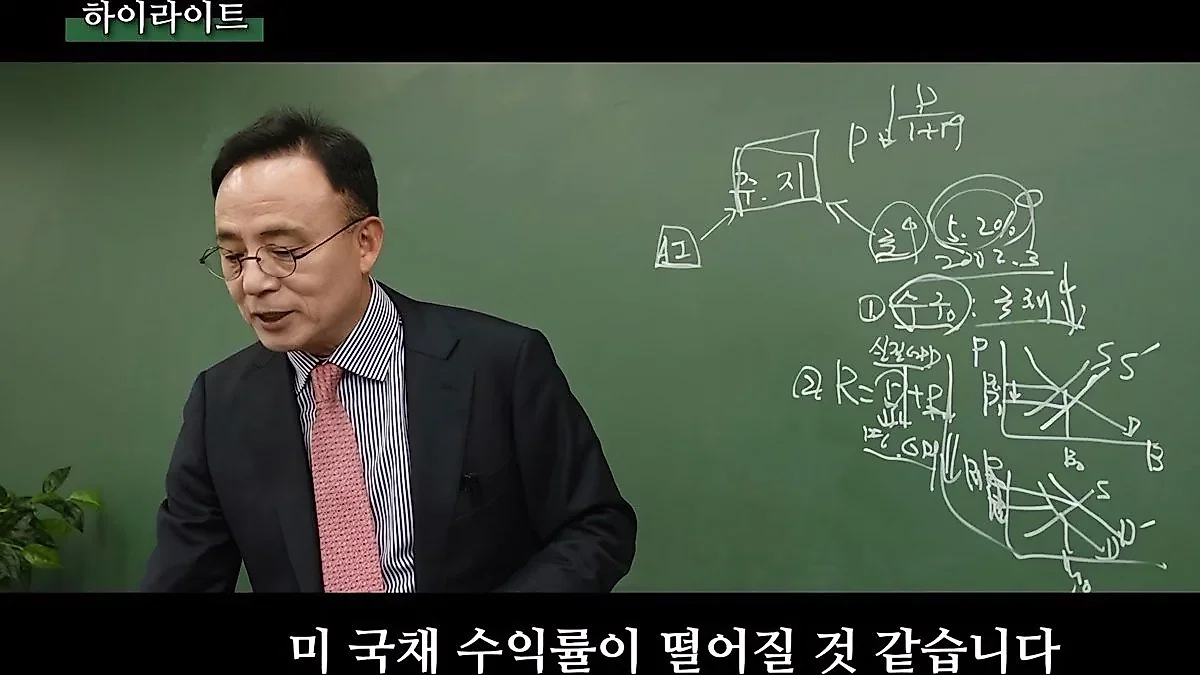
US Treasury yields are soaring into the low 5% range, increasing market uncertainty. As the US 10-year Treasury yield records its highest level since 2002, warnings are growing regarding the ripple effects that high interest rates will have on stock prices and corporate investment.
Analyzing recent market trends, Professor Kim Young-ik diagnosed the causes of the high-flying US Treasury yields and their future impact on the stock market. Pointing out that the US 10-year Treasury yield is moving in the 5.2–5.3% range, he noted that this is the highest level since March 2002. He warned, "These Treasury yields will cause stock prices to fall with a time lag and shrink US consumption and investment," specifically issuing a strong warning that investments related to AI (Artificial Intelligence) could contract.
'High-Interest Rate Swamp' Caused by Fiscal Deficit and Lack of Demand
The core reasons for interest rates remaining at such high levels are cited as the massive US fiscal deficit and the absence of demand for Treasury bonds. Professor Kim explained that the US federal government's debt has exceeded 120% of GDP, and the situation requires spending 3.2% of GDP annually on interest burdens. This is at a historic high. To cover the fiscal deficit, the US government must continue to increase Treasury issuances, but the problem is that there is insufficient demand to absorb them.
From a supply and demand perspective, the departure of foreign investors, who were major purchasers of US Treasuries in the past, is notable. In particular, China is continuously reducing its holdings of US Treasuries due to the influence of the US-China hegemony war. China's holdings of US Treasuries, which reached 1.27 trillion dollars at the end of 2013, plummeted by nearly half to the 618 billion dollar level last July. Furthermore, as the Fed is also implementing quantitative tightening and reducing Treasury purchases, a structural imbalance where supply increases while demand is not supported is pressuring interest rates upward.
For interest rates to fall, both the real GDP growth rate and the inflation rate must decrease so that the nominal GDP growth rate drops. Professor Kim predicted, "I think this phenomenon will appear next year, causing US Treasury yields to fall." Considering that the current US nominal growth rate is around 6.3%, he analyzed that the 10-year Treasury yield at the 5.9% level is showing a trend almost similar to the nominal GDP growth rate.
AI Bubble Debate and Potential Crisis for Non-Bank Financial Institutions
A high-interest rate environment increases the cost of financing for companies, dealing a direct blow to the real economy. Professor Kim linked the current situation to the possibility of an 'AI bubble burst.' While agreeing that AI technology will have a massive impact on human history, he warned, citing past examples, "The technology remains, but investment capital can be destroyed on a large scale." Mentioning the case during the dot-com bubble in the 1990s when the Nasdaq Composite plummeted by nearly 80% from its peak, he analyzed that the current S&P500 and Nasdaq Composite are also in a state where the largest bubble in history has occurred.
A risk that deserves particular attention is the soundness of non-bank financial institutions (NBFI). As Treasury yields surged recently and Treasury prices fell, non-bank financial institutions holding large amounts of Treasuries are incurring losses. The proportion of advanced country bond holdings by non-bank financial institutions increased from 44% in 2001 to 53% last year. Professor Kim said, "If non-bank financial institutions realize losses or resell Treasuries in the futures market, interest rates could temporarily surge even further." This could eventually create a vicious cycle where it becomes difficult for AI companies to raise funds through commercial credit or corporate bonds, thereby shrinking investment and accelerating the decline in stock prices.
In fact, he cited the case of Samsung Electronics, where the stock price fell significantly despite recording 17 trillion won in profit in the third quarter, suggesting the possibility that the AI-related bubble debate may already be priced into stock prices. Professor Kim explained, "Stock prices are very smart. When stock prices fall, the reason appears in the market a few months later," suggesting that the sharp drop in stock prices last July might have pre-reflected the phenomena that will appear in the future.
Limits of the Fed's Response and Future Observation Points
The problem is the ability to respond to crises. During past financial crises, the Fed supplied liquidity to the market through quantitative easing, but currently, the inflation trend (exceeding 3% based on PCE) remains, making it difficult for the Fed to actively loosen money. Professor Kim warned, "The Fed cannot loosen money because of inflation, and it is impossible to support non-bank financial institutions when there is a shortage of funds in banks," suggesting that a crisis of a different form from the past could arrive. In particular, the fact that Fed Governor Kevin Warsh holds a negative view on quantitative easing was also cited as a variable.
As a condition for falling interest rates, Professor Kim mentioned 'Marshall K.' Marshall K is the value obtained by dividing M2 (money supply) by nominal GDP, based on the logic that interest rates fall when the money supply increases relative to the real economy. The case during the 2020 COVID-19 period, where Marshall K surged and the US 10-year Treasury yield fell to 0.5%, supports this. On the other hand, currently, due to the Fed's tightening, the money supply is decreasing relative to the real economy, placing it in a phase where interest rates are rising.
As an indicator to read future market risk signals, the 'US credit spread' was presented. Professor Kim analyzed, "The US credit spread is in the process of hitting a bottom and rising up," noting that since this spread reflects the difference between high-yield bonds and the US 10-year Treasury yield, the US economy could become quite dangerous if the spread exceeds the long-term average of 5.2%. He added, "When that moment comes, stock prices will fall first along with it."
Source: original video (YouTube)

0Comments
Comments are currently disabled.