
AI is redefining work rules and driving South Korea's economic rebound
The advancement of AI is fundamentally altering national economic growth drivers and individual career survival strategies, creating a divide between those who utilize AI and those replaced by it.
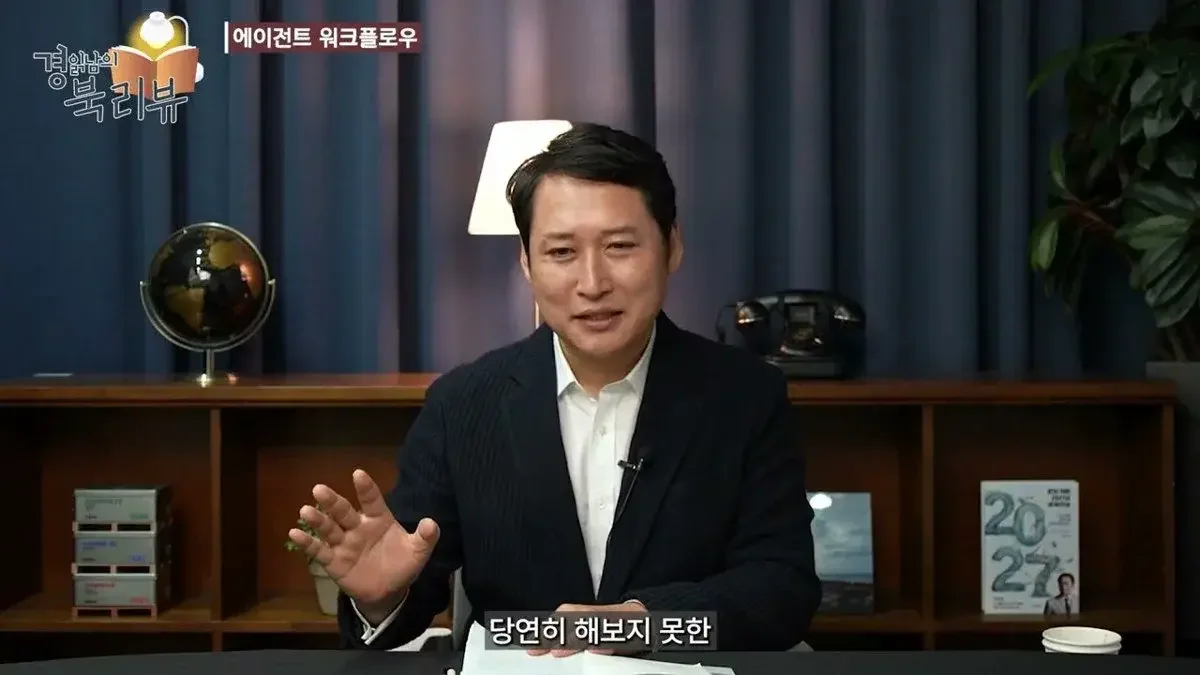
South Korea's potential growth rate is expected to rise to 2.2% next year as the nation leverages the AI value chain. This shift toward Agentic AI is changing the rules of work, creating a divide between individuals who utilize the technology and those who are replaced by it.
The advancement of artificial intelligence (AI) technology is moving beyond the evolution of simple task-assistance tools to fundamentally shake up the growth engines of national economies and the survival methods of individuals in their careers. As the economic gap widens between nations that contribute to creating AI and those that do not, projections suggest a class division will emerge at the individual level between those who utilize AI and those who are replaced by it.
According to this analysis provided by The Man Who Explains the Economy (Kim Kwang-seok TV), the global economy has entered a low-growth phase, recording a growth rate of 3.1%, the lowest since the pandemic. This is a distinct slowdown compared to typical growth rates that ranged between 3.3% and 7%. However, the South Korean economy, which is participating in the AI value chain, shows an exceptional trend. This stands in contrast to most of the 192 countries that live independently of AI, which are experiencing economic shocks due to inflation and international oil price shocks caused by wars in the Middle East. South Korea's economic growth rate is recording levels of approximately 3.3% based on IMF diagnosis and approximately 3.6% based on OECD diagnosis, fully experiencing the "economic windfall" enjoyed by leading AI nations. This is interpreted as a "reverse flow of money" brought by AI, as South Korea's potential growth rate, which had been declining for 40 years, rebounded from 1.9% last year to 2.1% this year and is expected to continue to 2.2% next year, marking a rebound for two consecutive years.
Samsung Electronics performance and current account surplus... "Unprecedented boom" created by AI
The economic ripple effects brought by AI are proven through corporate performance and national trade balances. Professor Kim analyzed that Samsung Electronics' operating profit is showing a level unprecedented in human history, excluding the case of Saudi Aramco. Saudi Aramco once recorded an operating profit of approximately 110 trillion won in 2022 due to a surge in international oil prices; excluding that, the current single-company performance of Samsung Electronics is at a massive level that even global big tech companies such as Apple, NVIDIA, and Tesla have not experienced.
This corporate prosperity is leading to record-breaking exports, trade surpluses, and current account surpluses. In particular, South Korea's current account surplus in 2026 is projected to be the world's largest after China according to IMF diagnosis, with South Korea ranking 2nd. The scale appears to be large enough to exceed the combined current account surpluses of Germany and Japan, which rank 3rd and 4th, signaling strong favorable conditions in external transactions. This trend, judged based on second-quarter results, will have a massive impact on national finances.
An unprecedented excess tax revenue of approximately 150 trillion won is expected to have a decisive influence on the determination of the 2027 budget. This excess tax revenue is expected to act as a 12% increase factor in the 2027 budget, creating an unprecedented trend of increased expenditures. Ultimately, the structure is such that nations and companies that preoccupy AI technology and contribute to its ecosystem will hold economic leadership.
Transition from an era of questioning to an "era of setting goals"
When the economic flow narrows from the national level to corporations and then to individual jobs, the topic of the "end of white-collar work" emerges. Citing the book Agent Workflow by Ro Sajang (Kim Da-sol), Professor Kim emphasized that we have entered an era where it is not humans fighting against AI, but "people who utilize AI" fighting against "people who are replaced by AI." This is because the rules of work are changing completely.
Human roles change according to the stages of AI development. If 1st generation AI was "Chatbot" type that answers simple questions, 2nd generation AI is "Inference" type that analyzes problems and finds solutions. The 3rd generation AI we are currently entering is "Agentic AI," a stage where it independently performs goals, makes plans, and executes them. Up to the 2nd generation, the structure was that humans ask questions and AI answers, or humans make judgments based on AI's reasoning. In contrast, in the 3rd generation Agentic AI era, AI takes charge of investigation, scheduling, and task execution, so the core for humans is to instill clear "goals" and "standards" into the AI.
In this process, the human role is elevated from a simple questioner to a "judge" who sets guidelines so that the AI can act according to the goals and makes the final decisions. In the video, Kim explained that treating AI like an equal persona and the process of setting sophisticated goals and standards will be the core competency in the Agentic AI era. In fact, he mentioned an attitude of treating AI as an equal persona during the process of training and educating AI, such as using honorifics when communicating with AI.
The destructive power of AI changing the "rules of work" rather than being a tool
The essence of the change brought by AI lies not in the simple "introduction of a tool" but in changing the "rules" of work itself. Much like the introduction of the wheel and electricity in the 1700s–1800s or the introduction of the internet in the 1900s, AI is redefining the work process itself. AI does not merely reduce work time; it acts as a tool for maximizing productivity that explosively increases the amount of work (output) an individual can handle.
In fact, those who utilize AI increase their output by using the time secured through improved work efficiency to perform more projects, or conversely, they are required to exercise a higher level of judgment to handle the increased workload. As seen in the case of the author in the video, while the amount of work that can be done—such as organizing thoughts in one's head or searching for data in minutes thanks to AI—has increased several times over, paradoxically, the density of work increases, sometimes creating more frantic situations. Ultimately, the direction of maximizing productivity is determined by whether one fixes the amount of work or increases it.
Professor Kim predicted that around 2027, the era of "Physical AI," which goes beyond Agentic AI to interact with the physical world, will begin in earnest. At that time, the influence of AI may expand not only to white-collar areas but also to blue-collar areas, making it essential to reorganize one's own response strategies in accordance with the changing rules of work. It is a time when contemplation is needed on how to actively utilize AI rather than being replaced by it.
Source: original video (YouTube)
0Comments
Comments are currently disabled.