
Pusan National University researchers develop integrated robot hardware and AI control
Researchers at Pusan National University's Camel Lab are building the foundations of robotics by designing everything from frames and motors to AI control systems in-house. Their work spans humanoid and quadrupedal robots, including a guide robot project for people with a visual impairment.
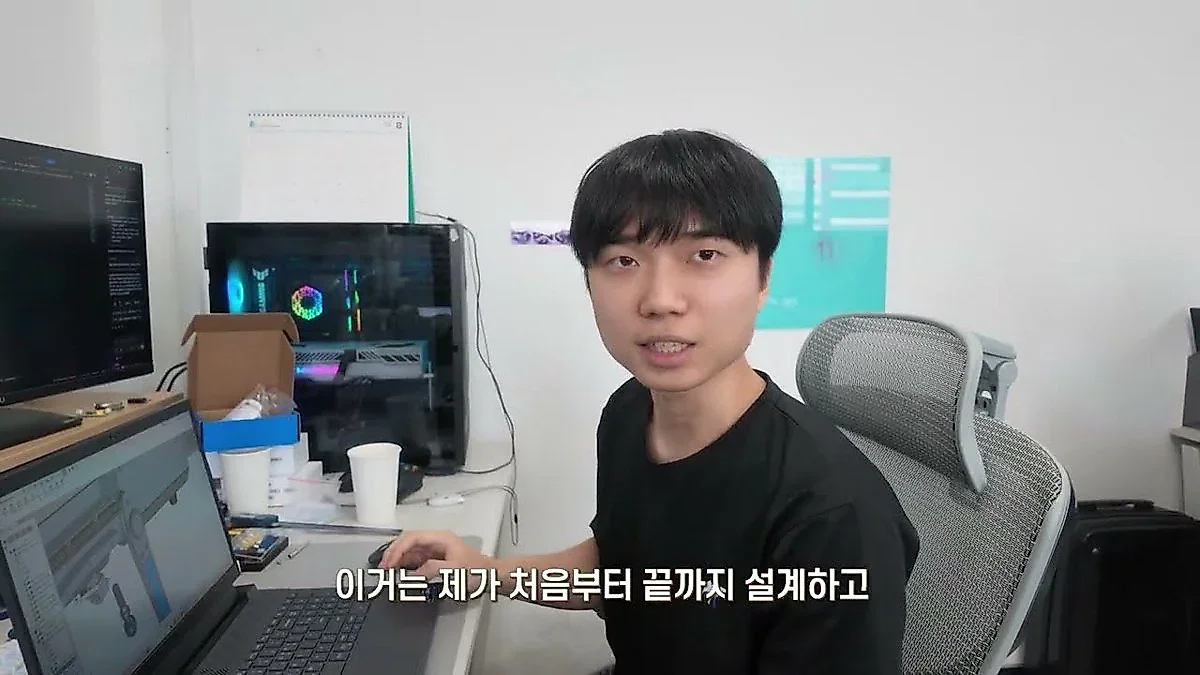
Researchers at Pusan National University's Camel Lab are building robots from the ground up by designing their own frames and motors. The lab is currently developing a quadrupedal robot named K9 and robot hands with 17 degrees of freedom to assist the socially vulnerable.
The process of making robots resemble human movement is not completed simply by inputting software. It requires a series of interconnected processes, including designing the frames that serve as the robot's skeleton, the motors that act as joints, and the AI control technology to move them. Researchers at Pusan National University's Camel Lab are building these robotic foundations by performing all these processes themselves without relying on finished products from external sources.
The Core of "Hands-on" Robot Research: From Design to Assembly
The research site of Pusan National University's Camel Lab, revealed by the Ministry of Trade, Industry and Energy, hosts various platforms including humanoids, quadrupedal robots, robotic arms, and wheeled bipedal robots. The core of their research is "touching and connecting things directly." Researchers design frames from design files, assemble motors, and then upload controllers, as hardware and software are closely linked.
One researcher stated that they perform everything from hardware design to the end and are currently researching control technology to enable robot movement. Because even a tiny difference in angle during the design stage makes it difficult to distinguish whether a problem is a hardware defect or a software error, researchers closely observe each other's fields and collaborate. One researcher explained that "the process of sharing opinions and coordinating with colleagues is the key to problem-solving," noting that indirect growth is possible simply by watching colleagues solve problems.
The research fields are broad, ranging from locomotion, which handles robot movement, to the development of walking controllers and core technologies for robots with manipulation capabilities. The laboratory's goal is to provide an environment where students can grow together by sharing ideas. Researchers noted that "one person's work becomes the starting point for the next stage," adding that hardware production must be completed quickly so the control team can move to the next process and continue improvement work.
'Robot Hands' Mimicking Human Hands and Technology for Society
The scope of research extends to "robot hands" that implement sophisticated movements. The robot hands currently under research possess 17 degrees of freedom (DOF) to implement movements similar to human hands and control fingers using tendons that mimic human tendons. Researchers are focusing on building control systems so that robots can grasp and manipulate various objects like actual humans. In particular, attempts are being made to implement new control systems on robot hands based on open-source designs.
The direction of the technology does not stop at mere mechanical perfection. The quadrupedal robot 'K9' developed in the lab has the ability to detect obstacles through sensors, generate maps, and move to a destination autonomously. Notably, researchers are conducting a "guide robot" project for people with a visual impairment. By utilizing robots to address the shortage of actual guide dogs, they are seeking ways for technology to provide practical help to the socially vulnerable.
These research achievements are tested on stages such as the "Humanoid Challenge," where humanoid robots gather in the summer of 2026. Beyond testing the performance of robots moving in an arena, the essence of the research is treated as a process of expanding human experience by staying up all night to reassemble robots rather than remaining stuck in fixed code.
A Process of Identifying Causes of Failure Creates the Future
The process of robot research often does not go as expected. When a robot designed in-house does not move as intended, researchers spend time analyzing the cause instead of erasing the failure. This is due to the laboratory's philosophy that "you must be able to explain the reason for failure to be able to explain the next success." This process serves as an opportunity for researchers to broaden their perspectives into new fields such as AI rather than being immersed in a single methodology. One researcher mentioned that by stepping away from existing research methods to study AI, they realized their perspective had been narrow.
Researchers agree that robot technology should ultimately contribute to making human life more comfortable. A short-term goal is to enable humanoids or multi-legged robots to move smoothly in difficult terrains, such as disaster sites. To this end, efforts are continuing to develop imitation learning research into technology applicable to real-life situations.
Experiments in the laboratory are expected to continue until the day robots move perfectly according to the designer's intentions. While some make robots to help the socially vulnerable and others to become researchers solving more difficult problems, their common goal is that robots ultimately make the tomorrow of humans more comfortable.
Source: original video (YouTube)



0Comments
Comments are currently disabled.