
Lim Sangwoo Reporter

Silicon photonics and CPO could solve AI factory data bottlenecks
The competitiveness of AI semiconductors is shifting from individual chip calculation speeds to the efficiency of data movement through technologies like silicon photonics and Co-Packaged Optics (CPO).

KOSPI falls to mid-5,000 level as AI profitability concerns grow
Treasury bond yield uptrend reverses as government reduces issuance

CJ ENM partners with MBC Group to expand K-content in MENA
CJ ENM has signed a strategic partnership with MBC Group to supply K-content through a dedicated TVING brand hub on the MBC Shahid OTT platform and via the MBC4 broadcast channel.

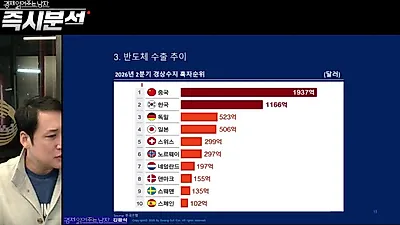
IMF raises South Korea's growth forecast to 3.3% on semiconductor demand
The IMF has raised South Korea's economic growth forecast to 3.3% for this year, driven by surging semiconductor exports, even as energy-driven inflation creates a gap between economic indicators and consumer sentiment.

CJ ENM launches CJ DMP to enhance TV advertising targeting
CJ ENM has launched 'CJ DMP', a Data Management Platform that integrates non-identifiable data from its media and commerce affiliates to innovate data-driven TV advertising.
SK hynix surpasses 100 trillion won in quarterly revenue, announces 60 trillion won shareholder return plan
SK hynix has achieved record-breaking quarterly revenue of 104.6155 trillion won and an operating profit of 83.3338 trillion won, marking its sixth consecutive quarter of record results. Alongside these results, the company announced a 60 trillion won shareholder return plan, including 30 trillion won in cash dividends.

AI evolves from passive tools into autonomous agents
Artificial Intelligence is transitioning from passive tools that respond to prompts into "AI Agents" capable of understanding goals, planning tasks, and taking autonomous initiative.

Parking robots capable of lifting 1-ton cars showcased in Gangneung
The 2026 Gangneung ITS World Congress showcased the future of mobility, featuring autonomous driving, AI, and drones that aim to make daily transportation safer and more convenient.

Soongsil University undergraduates redesign robot waist to expand workspace
Undergraduate students at Soongsil University's MAIROBOT lab are redesigning a robot's waist structure to increase its reach and operational workspace.

South Korean potential growth rate could reverse 40-year downward trend
Professor Kim Kwang-seok analyzes potential shifts in South Korea's potential growth rate and the mechanisms of bond yields, oil prices, and exchange rates that will influence future inflation.

New electronic real estate contract system automates transaction reporting
Users must still manually handle move-in notifications and non-residential lease fixed date requests

Professor Kwon Seok-jun: "Dense AI Ecosystem is Key to Semiconductor Hegemony"
Professor Kwon Seok-jun of Sungkyunkwan University emphasized that the essence of semiconductor competitiveness lies in a dense ecosystem rather than individual technologies, as AI drives the need for interconnected components. He highlighted the "Trinity FAB" project in the Yongin Semiconductor Cluster as a vital solution to help domestic suppliers verify products in mass-production environments.

Digital transition replaces paper receipts with electronic tax invoices and e-receipts
Businesses can receive tax credits of up to 1 million won annually, while consumers are warned that e-receipts do not replace cash receipts for tax deductions.

CXMT challenges Samsung and SK hynix with new 4F² DRAM technology
Chinese semiconductor firm CXMT is signaling its entry into the server DRAM market by leveraging next-generation 4F² technology, potentially challenging the dominance of South Korean leaders.

NVIDIA to launch $500 billion AI infrastructure financing platform
Financial institutions weigh the future value of GPUs as NVIDIA seeks to pioneer a new era of "Compute Financing"

Cheonggus reduces unpaid receivables by 83% through automated collection
After two failed startups, CEO Lee Jang-gyu founded Cheonggus, a solution that automates the entire process from invoicing to debt collection to solve the massive problem of unpaid receivables.

Hyundai Motor reveals development of first mass-produced software-defined vehicle
Hyundai Motor Company has shared the development details of 'The New Grandeur', its first mass-produced software-defined vehicle (SDV) designed to evolve through continuous software updates.

National Tax Service enhances filing convenience through pre-filled tax returns
The National Tax Service is highlighting the evolution of information delivery, from the Joseon-era relay courier systems to the modern pre-filled tax return service.

Late applicants can receive 95% of incentive payments until December 1
Workers and child-rearing households that missed the regular application period can apply for incentive payments through a late application process until December 1.

US dollar stablecoin expansion could neutralize Bank of Korea policy
Experts warn that the rapid spread of US dollar-based stablecoins could undermine South Korea's monetary sovereignty and economic governance by absorbing domestic economic capacity into the US economic sphere.

Cooling technology emerges as key to overcoming AI infrastructure constraints
As physical constraints on land, chips, and power limit AI infrastructure growth, advanced cooling technologies are becoming the primary way to increase computing power.

Nazi Germany used confiscated Jewish assets to fund public welfare
Analysis suggests Nazi Germany maintained domestic stability by redistributing confiscated Jewish wealth to the public through welfare benefits, effectively making citizens economic accomplices to the regime.

Switching pension insurance to funds could quadruple retirement assets
A difference in management strategies between pension insurance and pension funds can lead to a fourfold difference in accumulated assets, according to Hong Chun-uk's Economics Lecture Notes.

AI market differs from dot-com bubble due to hyper-scaler leadership
Economics Master Kwak Soo-jong argues that the current AI boom is fundamentally different from the late 1990s dot-com bubble due to the nature of the capital and infrastructure involved. Unlike the speculative hedge fund-driven era of the dot-com bubble, the AI market is led by hyper-scalers with significant financial stability.
Silicon photonics and CPO could solve AI factory data bottlenecks
KOSPI falls to mid-5,000 level as AI profitability concerns grow
CJ ENM partners with MBC Group to expand K-content in MENA
IMF raises South Korea's growth forecast to 3.3% on semiconductor demand
CJ ENM launches CJ DMP to enhance TV advertising targeting
SK hynix surpasses 100 trillion won in quarterly revenue, announces 60 trillion won shareholder return plan
AI evolves from passive tools into autonomous agents
Parking robots capable of lifting 1-ton cars showcased in Gangneung
Soongsil University undergraduates redesign robot waist to expand workspace
South Korean potential growth rate could reverse 40-year downward trend
New electronic real estate contract system automates transaction reporting
Professor Kwon Seok-jun: "Dense AI Ecosystem is Key to Semiconductor Hegemony"
Digital transition replaces paper receipts with electronic tax invoices and e-receipts
CXMT challenges Samsung and SK hynix with new 4F² DRAM technology
NVIDIA to launch $500 billion AI infrastructure financing platform
Cheonggus reduces unpaid receivables by 83% through automated collection
Hyundai Motor reveals development of first mass-produced software-defined vehicle
National Tax Service enhances filing convenience through pre-filled tax returns
Late applicants can receive 95% of incentive payments until December 1
US dollar stablecoin expansion could neutralize Bank of Korea policy
Cooling technology emerges as key to overcoming AI infrastructure constraints
Nazi Germany used confiscated Jewish assets to fund public welfare
Switching pension insurance to funds could quadruple retirement assets