
Hanwha Challenges 'Korean SpaceX'... Aiming to Secure Sovereignty by Building Independent Space Infrastructure
Hanwha Group is building a complete space industry value chain, from launch vehicles to satellites…
Space is evolving beyond the realm of imagination into a massive industrial domain. Space development, which was previously driven by systemic competition between nations and military purposes, is now transforming into a platform industry that creates economic value as it enters the 'New Space' era led by private companies.
From 'Old Space' to 'New Space'... Space is Now a Domain of Manufacturing
The space industry of the past was referred to as so-called 'Old Space.' The space race, which began with the launch of the Soviet Union's Sputnik 1 in 1957, triggered systemic and military competition between the United States and the Soviet Union. At that time, the United States felt the threat that satellites could be converted into nuclear warheads to strike the mainland, leading to the creation of NASA in 1958, and large-scale state-led projects were central, such as the U.S. President delivering a speech toward moon exploration after Yuri Gagarin reached space in 1961. The method involved NASA leading the projects and large defense companies manufacturing products according to those designs.
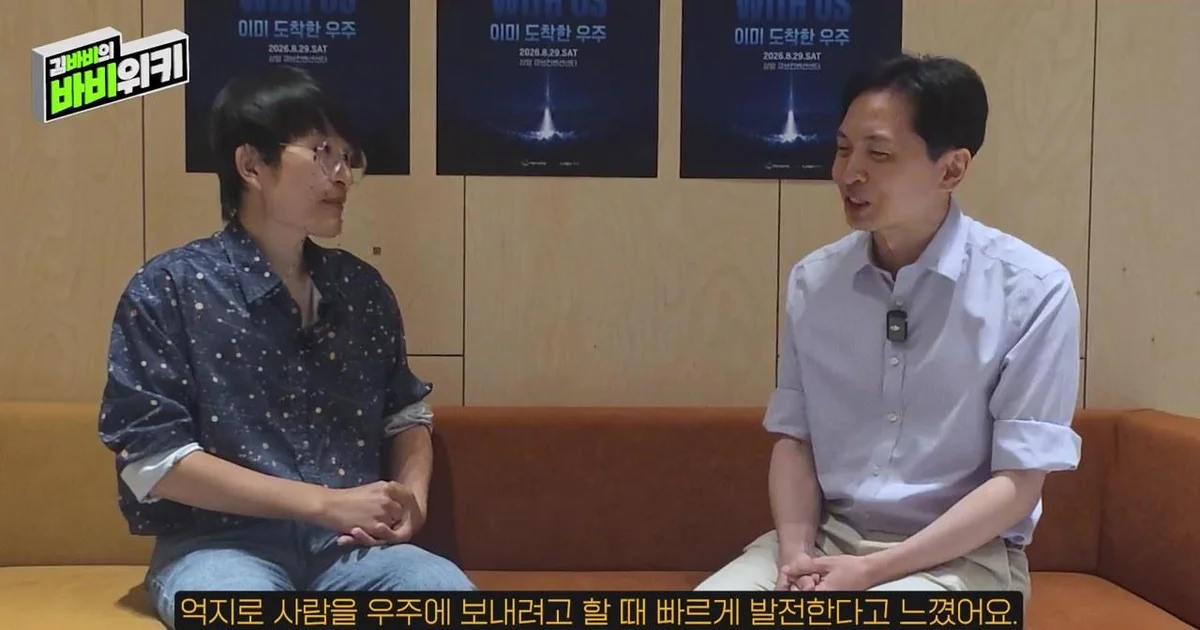
According to a video from 'Kim Bobby's Bobby Wiki,' after manned moon exploration was halted following Apollo 17 in 1972, the space industry shifted from an 'industry for going to the moon' to an 'industry for using space.' Representative examples include watching overseas sports broadcasts through satellites or the establishment of daily infrastructure such as car navigation, smartphone maps, delivery, logistics management, and agriculture through GPS opened to the public. Space has become a single platform and infrastructure.
In the 2000s, the paradigm shifted with the emergence of private companies like SpaceX. As NASA transitioned from direct development to playing the role of a 'customer' purchasing services from private companies, rocket launches became established as standardized private services, much like 'Coupang's Rocket Delivery.' This change was accompanied by technological progress. The emergence of reusable launch vehicles allowed for increased launch frequency and cost reduction, and as satellites became smaller due to advancements in semiconductor, sensor, and battery technologies, the space industry expanded into the domain of 'manufacturing' where satellites can be mass-produced. Now, space functions as core infrastructure encompassing communication, data, and defense.
Hanwha: Why Pursue Independent Technology Development Despite the Existence of 'SpaceX'
In a situation where the global leader SpaceX exists, the key reason why a Korean company must spend massive costs to develop independent space technology is cited as securing 'space sovereignty.' The video pointed out that SpaceX uses more than 70% of its total launches to launch its own satellites and has announced that its additional launch slots may be full for the next few years, potentially not accepting external launches. The logic is that if one relies only on other countries while a technological gap exists, one will inevitably be subordinate to the schedules and approvals of other nations during national crises.
Following this necessity, Hanwha Group is building the entire value chain of the space industry, from launch vehicles to satellites and data transmission. The plan is to equip the capabilities of a comprehensive space company through a lineup including Hanwha Aerospace (Nuri engine and system integration), Hanwha Systems (satellites and space communication), and Satrec Initiative (ultra-high-resolution optical satellites). In particular, the high technological correlation between the defense industry and the space industry was mentioned as one of the major backgrounds for Hanwha entering this field. As a group possessing both capital power and technological similarity, Hanwha is continuing long-term investments by operating 'Space Pebble,' an educational program to nurture future space talent together with KAIST.
Changes in Daily Life Brought by Space Technology... From Water Purification Technology to Data Platforms
The development of the space industry does not stop at mere space exploration but drives technological innovation on Earth. Professor Ji Woong-bae, who appeared in the video, explained that space technology is transferred into unexpected daily technologies during the process of sending humans into space. A representative example is the technology developed for astronauts' meals during the Apollo era, which became the foundation for retort foods. Additionally, the cooperation structure between government and private sectors is changing, such as private companies supporting Mars sample collection missions to alleviate the burden faced by NASA due to budget issues.
When moon exploration begins in earnest in the future, a task will arise to filter out extremely fine 'moon dust' during the process of utilizing ice at the lunar south pole, which could serve as an opportunity to leapfrog the development of Earth's water purification technology. Professor Ji expressed expectations for the long-term growth of the space industry, stating, "The space industry may feel like a field far removed from the economy, but the incidental byproducts generated as the industry develops will determine the richness of our lives."
0Comments
Comments are currently disabled.