
"Currency Diversification is a Necessity, Not an Option"... Asset Allocation Strategy Proposed by Dr. Hong Chun-uk
Economist Dr. Hong Chun-uk emphasizes that diversifying currencies is essential for improving returns and ensuring stability during market adjustments. He proposes various asset allocation methods, such as the "Four-Part Investment Method," and suggests using PISA scores to identify high-growth countries for global investment.
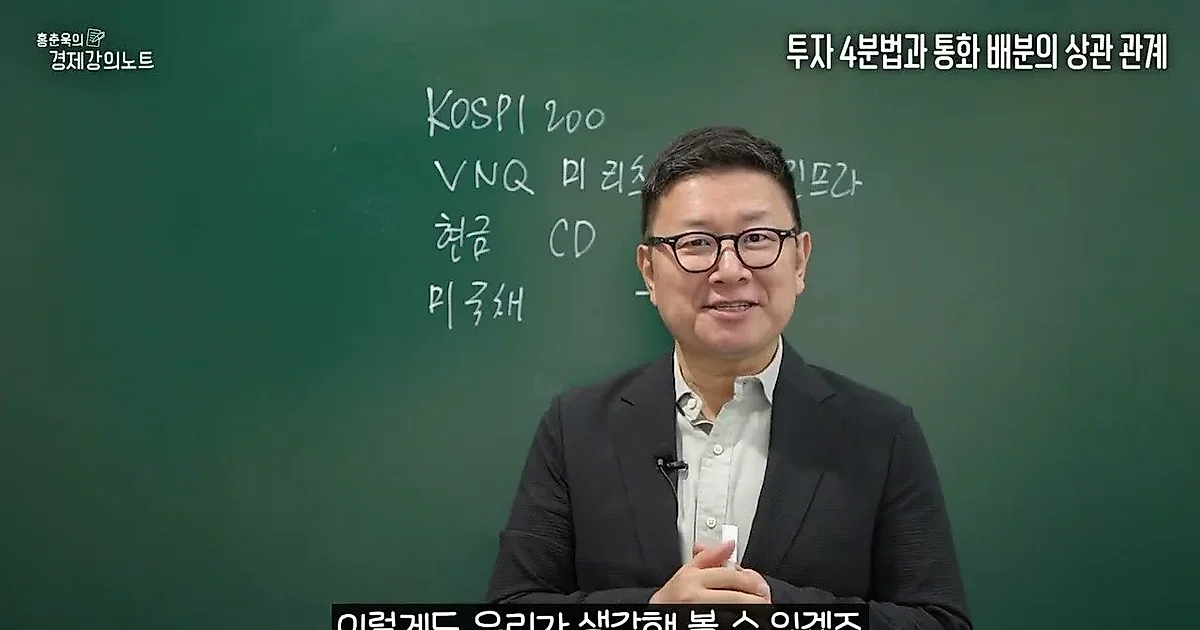
An analysis has emerged stating that currency diversification plays a key role in improving returns and securing stability during the asset allocation process. It is explained that because the direction of exchange rate changes between countries differs, holding a proper mix of currencies can increase defensive capabilities during market adjustment periods and expand the scope of profits during upward trends.
The Impact of Currency Diversification on Portfolio Stability
Economist Dr. Hong Chun-uk emphasized the importance of currency diversification during asset allocation in the video. According to Dr. Hong, rather than constructing a portfolio with only a specific currency, mixing multiple currencies showed relatively higher defensive power during market adjustment periods, such as 2022 or early 2025. Conversely, the analysis showed that the explosive power of profits was also better during bull markets.
The core components of the 'Four-Part Investment Method' presented by Dr. Hong are four. Specifically, it consists of Korean stocks (KOSPI 100), US REITs (VNGQ), cash (CD ETF), and US Treasuries. If these are replaced with domestic Korean won assets, domestic real estate infrastructure ETFs can be used instead of US REITs, and Korean government bonds can be used instead of US Treasuries. However, citing backtest results, Dr. Hong explained that portfolios composed only of Korean won tend to have lower returns and higher volatility compared to portfolios that mix in US dollars. On the other hand, he added that holding 100% in US dollars could lead to increased volatility due to exposure to exchange rate fluctuations, making currency diversification necessary.
Correlation Between PISA Scores and Economic Growth Rates
As a criterion for which countries to watch for global asset allocation, Dr. Hong presented PISA (Programme for International Student Assessment) scores. According to the data presented by Dr. Hong, a strong correlation exists between PISA scores and per capita economic growth rates. Countries such as Korea, Singapore, Hong Kong, and Vietnam, where educational investment is active and students' scores are among the highest in the world, tend to show high growth rates.
On the other hand, countries with low educational investment and low student scores, such as the Dominican Republic, Qatar, Argentina, Brazil, Mexico, Colombia, and Peru, showed relatively low growth rates. Dr. Hong explained that one can judge countries with a bright future based on these indicators, and among European countries, he mentioned Estonia and Poland positively. He also suggested that, in addition to the US market, one could include Japan, which is on a growth trend, and India, considering its economic momentum through the influx of talent into the US, into the portfolio.
Advancing Portfolios Through Expansion of Investment Assets
Dr. Hong explained that the more types of investment assets there are, the more advantageous it is to expand the 'Efficient Frontier'. Since there are often insufficient REIT products to invest in domestically, the intention is that it is important to increase the types of assets by including overseas assets.
Beyond the existing 'Four-Part Investment Method', if Japanese yen or China-related assets are added, it is possible to expand to the 'Seven-Part Investment Method' or 'Ten-Part Investment Method'. For example, if the weight of Korean stocks is judged to be excessively high compared to its weight in the global market (2–4%), the weight of Korean stocks can be reduced to 10%, and the remaining weight can be diversified into China, India, Japan, etc., to construct a portfolio. Dr. Hong guided that utilizing domestically listed MSCI World ETF, etc., can be helpful for global diversified investment.


0Comments
Comments are currently disabled.