
US 30-Year Treasury Yield Surpasses 5.5%, Has the Era of Low Interest Rates Ended?
The yield on 30-year US Treasury bonds has surged to around 5.5%, reaching its highest level since 2004. This rise is driven by factors such as the Term Premium, increasing US fiscal deficits, and shifting foreign investor patterns, including a significant reduction in holdings by China.
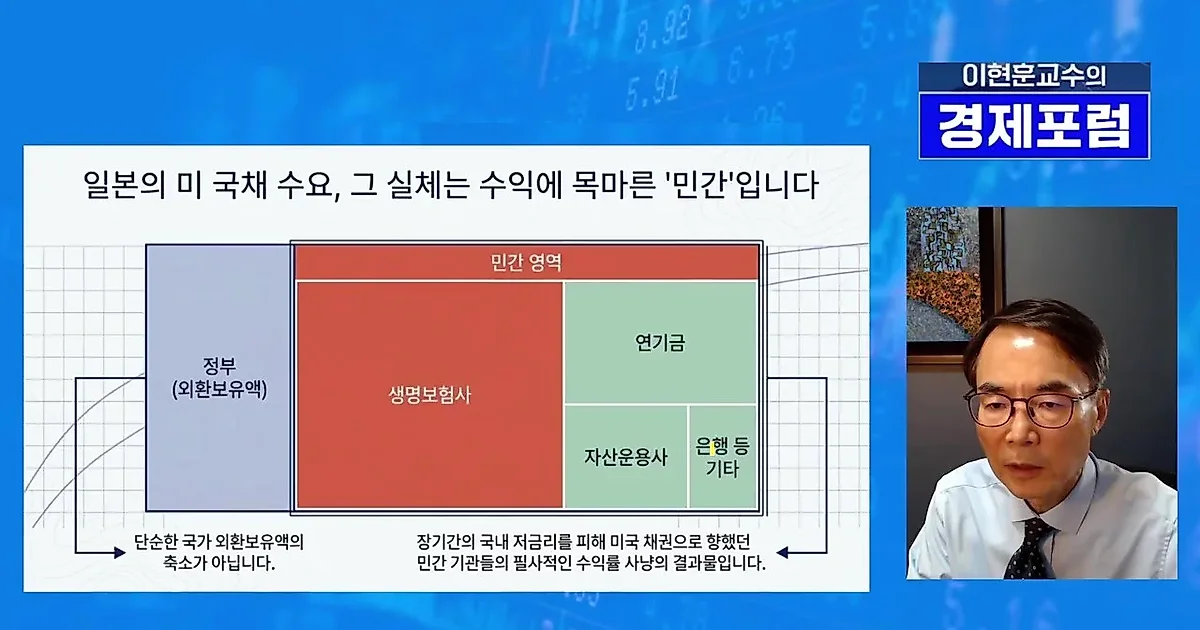
The yield on 30-year US Treasury bonds has soared to around 5.5%, recording its highest level since 2004. As long-term US Treasury yields rise rapidly recently, tension is mounting in bond markets worldwide. According to a video from Professor Lee Hyun-hoon's Economic Forum, the US 30-year Treasury yield rose from 5.27% at the beginning of this week to the 5.5% level, a sudden surge of 23bp (0.23 percentage points) in a short period.
Long-term Treasury yields exceed Federal Reserve base rates... influenced by 'Term Premium'
The current upward trend in US long-term Treasury yields shows a pattern that is differentiated from the movements of the Federal Reserve's base interest rate. The video noted the phenomenon where long-term Treasury yields rise independently, separate from the flow of the Federal Reserve raising or lowering base interest rates. In particular, despite the Federal Reserve beginning to lower interest rates in the latter half of 2024, long-term Treasury yields have continued to rise.
One of the main causes cited for this phenomenon is the 'Term Premium'. The Term Premium is an indicator that reflects future uncertainties, such as the US economic growth rate, the scale of future fiscal deficits, and changes in creditworthiness due to the increase in national debt. The video explained that the massive US fiscal deficit and the resulting rapid increase in national debt are the core drivers pushing up long-term Treasury yields. Specifically, the analysis suggests that even in a situation where the economy is not bad, the structure of the government continuing fiscal deficit financing and increasing debt is inducing the rise in long-term interest rates.
Decrease in China's Treasury holdings and changes in foreign investment structure
The behavior of foreign investors purchasing US Treasuries is also changing. According to the video, as of July 2025, foreign holdings of US Treasuries stand at approximately $9.11 trillion; compared to the US fiscal deficit of $1.9 trillion over the recent year, the foreign buying momentum is unable to keep up with the issuance volume of US Treasuries. Additionally, it was pointed out that foreign investors are showing a clear tendency to prefer short-term Treasuries over long-term Treasuries.
Looking at the holding status by country, while Japan holds $1.011 trillion in long-term Treasuries and maintains a portfolio centered on long-term bonds, countries such as the United Kingdom, Luxembourg, and the Cayman Islands were found to have a relatively high proportion of short-term Treasury holdings. Meanwhile, the holdings of China, which was once the largest holder of US Treasuries, have decreased to less than half of the $1.32 trillion held in 2013. This is interpreted as a result of China gradually selling off US Treasuries in conjunction with the full-scale onset of the US-China hegemony competition.
Corporate bond issuance in the AI industry and the yield competition with Treasuries
Recent upward pressure on interest rates is linked not only to government debt but also to demand from the private sector. Due to the 'AI Super Cycle' following the AI (Artificial Intelligence) revolution, hyperscaler companies are investing massive amounts of capital and are issuing large volumes of corporate bonds to secure cash flow. In this process, corporate bond prices are falling and interest rates are rising.
As a result, the video explains that a relationship has formed in the market where Treasuries and corporate bonds compete by driving each other's yields higher. This upward pressure on interest rates not only leads to rising mortgage rates and corporate bond yields in the United States, but also forms a path that pulls up global long-term interest rates by causing synchronization in global bond markets through capital movement and exchange rate fluctuations.



0Comments
Comments are currently disabled.