
Global bond yields surge as U.S. 30-year Treasury exceeds 5.6%
Global financial markets are facing a "government bond seizure" as yields in major economies soar, driven by geopolitical risks, shifting monetary policies, and structural factors.

Global financial markets are facing a "government bond seizure" as the United States 30-year Treasury yield has climbed above 5.6%. This surge is being driven by a mismatch between contractionary monetary policies and fiscal expansion, alongside China's accelerated selling of U.S. Treasuries throughout 2026.
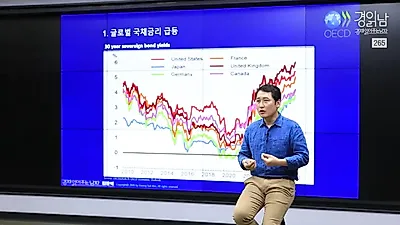
Global financial markets are suffering from a sudden surge in government bond yields, a phenomenon known as a "government bond seizure." Warning signs have been triggered in both the real economy and capital markets as yields in major countries soar, with the United States 10-year Treasury yield reaching 5.3%. Notably, the United States 30-year Treasury yield has exceeded 5.6%, signaling a sustained high-interest-rate environment.
According to an analysis by The Man Who Explains the Economy (Kim Kwang-seokTV), the current high-interest-rate phenomenon is not merely a single-country issue but a complex result of geopolitical risks, changes in monetary policy, counteracting fiscal policies, and structural factors. While United States Treasuries are considered the world's safest risk-free assets, rising U.S. rates force other countries to raise their own interest rates to defend against the selling of their own government bonds. As the U.S. 10-year Treasury yield acts as a guidance for global rates, it is leading to upward pressure on interest rates worldwide.
Geopolitical risks and the "mismatch" between fiscal and monetary policies
The first driver pushing up government bond yields is geopolitical tension. Whenever geopolitical instability, such as wars in the Middle East, intensifies, international oil prices spike, stimulating inflation concerns. While international oil prices, which peaked in 2022, showed a trend of downward stabilization following the Russia-Ukraine war, they have surged again following the Middle East war, impacting the global economy. Professor Kim assumes that the peak of geopolitical tension occurred in March 2026, with a second peak in September, and expects geopolitical tensions to ease somewhat in October. However, he diagnosed that as long as the United States does not withdraw from the Middle East, it is unknown whether the war will end completely, making future oil price trends a key variable for expected inflation and government bond yields.
The second factor is the shift in monetary policy direction. To respond to inflationary pressures, countries around the world have pivoted from a rate-cutting stance to a contractionary one. The United States changed its stance starting in mid-2026 and eventually raised interest rates in September. South Korea also implemented two interest rate hikes, and the eurozone recorded two benchmark interest rate hikes. However, as recent inflation indicators show more stability than expected and key Federal Reserve officials, such as John Williams and Jefferson, have stated that "there is no need to rush interest rate hikes," a slight decline in government bond yields has been observed.
The problem lies in the inconsistency with fiscal policy. While monetary authorities raise interest rates to control inflation, fiscal authorities are pursuing "fiscal expansion" policies, significantly increasing government spending to stimulate the economy. When a government increases the issuance of government bonds to expand fiscal spending, it acts as pressure to push up market interest rates. Professor Kim pointed out that such fiscal expansion is one of the structural factors deepening government bond instability.
China's selling of U.S. Treasuries and big tech capital demand
From a structural perspective, China's selling of U.S. Treasuries is cited as a major background for the rise in interest rates. China's holdings of U.S. Treasuries have been steadily decreasing since peaking around 2013. The selling trend has accelerated in 2026, following the pattern of the first quarter and accelerating further in June and July. China, which was once the largest holder of U.S. Treasuries, has now fallen to third in holdings. As the forces wanting to sell bonds (sellers) meet the forces wanting to increase issuance (issuers), a structure is formed where bond prices fall and yields rise.
Capital demand from the corporate sector is also a factor preventing yields from falling. This is because hyperscale big tech companies leading the global market are continuously engaging in large-scale capital expenditure (CAPEX) for future industries such as artificial intelligence (AI). These companies possess higher status and risk profiles than many nations and are actively issuing corporate bonds to carry out investments. This strong capital demand from big tech acts as a structural factor supporting upward pressure on interest rates in the bond market.
Impact of high interest rates on the real economy and capital markets
High government bond yields can cause a "crowding-out effect" that shrinks the new investment capacity of private companies. Concerns have arisen that as interest rates rise, the cost of financing for companies increases, which could ultimately lead to an economic contraction. In particular, if private companies face difficulties in actively conducting new investments by issuing corporate bonds, it could pose a threat to the real economy.
Capital markets are also within the influence of high interest rates. When interest rates rise, a phase is formed where cash becomes relatively more attractive. An environment is created where it is difficult for funds to flow into real estate or stock markets, resulting in situations where investors find it difficult to actively deploy funds into other areas, such as interest rates or the coin market. As such, the movement of government bond yields is becoming a key indicator that determines the investment capacity of the real economy and the flow of funds in capital markets.
Source: original video (YouTube)

0Comments
Comments are currently disabled.